 Receive up to €200 for referring your friends to ottonova.
 Callback
Get a consultation
Callback
Get a consultation
 +49 89 121 896 09
Talk to an expert
+49 89 121 896 09
Talk to an expert
One invoice at a time
To avoid any confusion, upload only one document at a time. This will also make it easier for you to assign the correct category to your document.
Here you'll learn: What digital documents we need from you to process your reimbursement requests quickly, how the document scanner in your ottonova app works, and what you should keep in mind when uploading documents.
Whether you have a full private health insurance plan or top-up insurance with ottonova, the process for submitting claims is the same for all ottonova policyholders.
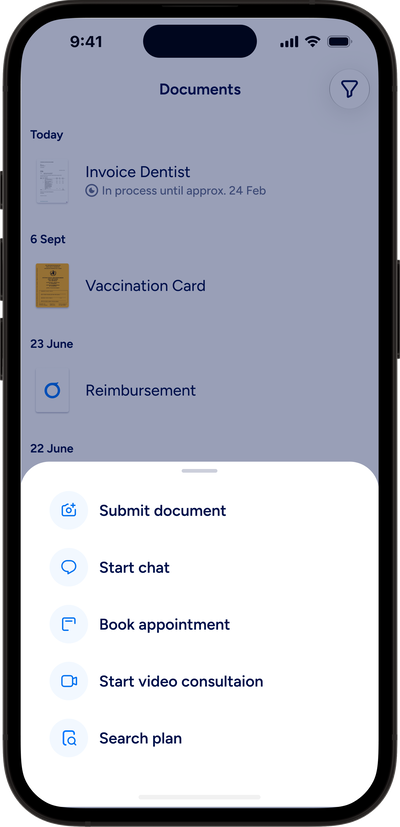
One invoice at a time
To avoid any confusion, upload only one document at a time. This will also make it easier for you to assign the correct category to your document.
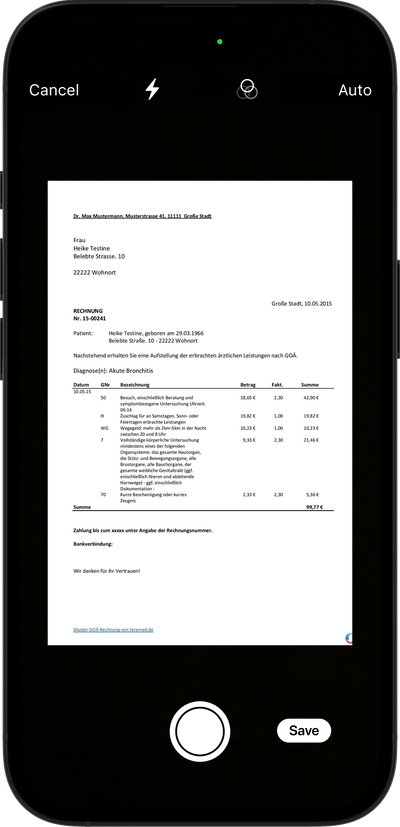
To help the app quickly recognize the outline of your document, place it on a surface with as much contrast as possible. Make sure you don't take the photo in dim light, as this will affect the readability and resolution of your image.

Everything should be clearly legible to prevent errors.

Make sure the header and footer are also in the picture.

Hold your smartphone as straight as possible and point it down at your bill from above.

Take the photo vertically, not horizontally.
For privately insured individuals, most private health insurance plans operate on a reimbursement basis. You pay your medical bill yourself first, submit the invoice, and then get reimbursed. With ottonova, you’ll usually have the money in your account before the payment deadline.
How much of the invoice amount we reimburse depends on various factors. These include, first and foremost, the benefits covered by your plan and, in the case of private health insurance, the deductible amount you’ve chosen.
Of course, you can also take a photo of your invoice or scan it using another app and then upload it to your ottonova app.
Just make sure the photo or scan is clear enough and that the invoice is legible. Otherwise, it may take longer to process your invoice or, in the worst case, prevent it from being processed at all.
Now you know how to easily upload documents using the ottonova app. To help you avoid scanning more pages than necessary, here’s a list of which documents we need from you—and which ones we don’t.
Important: The invoice first, then the rest
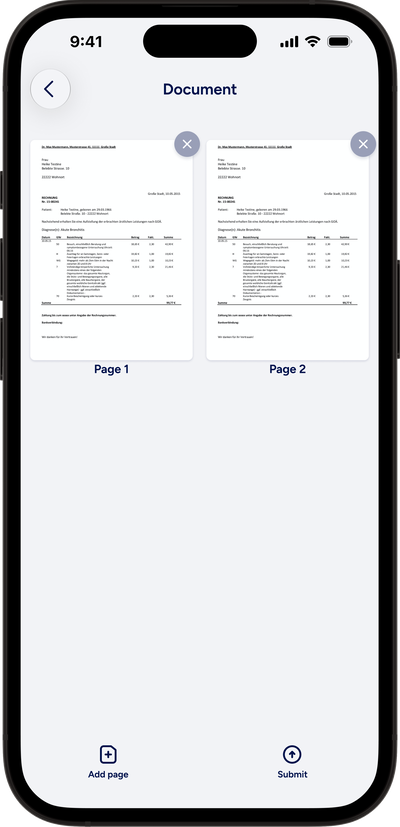
To ensure we can reimburse your invoice quickly, the invoice amount is our top priority. That’s why, for multi-page documents, the rule is: the invoice first, then the rest—for example, if you were hospitalized, you should upload the invoice first and any corresponding correspondence afterward.
For multi-page documents, the page numbers should, of course, be in the correct order. That way, nothing gets mixed up. A complete upload also includes photographing the headers and footers, as well as the back of your document if it’s printed on. This way, you can be sure that ottonova has all the information it needs to process your upload.
Some documents belong together. Examples include paperwork related to physical therapy or medical aids. In these cases, you, as the patient, often receive a prescription first and then an invoice. These documents belong together.
If you only have the prescription at first and want to know which rates you’ll be reimbursed for, you can clarify this via the chat feature in your ottonova app.
The process is slightly different for dental treatment: We need you to upload your dentist’s bill and the treatment and cost plan as separate files. We need the cost plan as soon as you receive it from your dentist so we can approve your claim as quickly as possible.
After the treatment, we’ll need the invoice from you for reimbursement. This, too, may consist of several documents: In addition to an invoice for the medical treatment, you’ll often also receive an invoice for material and lab costs.
Are you covered by public health insurance and have you, for example, taken out top-up dental insurance with ottonova? If so, uploading invoices in the app works the same way for you as it does for those with comprehensive coverage.
At the dentist’s office, you’ll usually receive two forms. To reimburse your dental expenses, we need the itemized estimate from your statutory health insurance provider. When uploading the documents, we ideally need all forms related to your treatment from you.
For top-up dental insurance, your reimbursement depends on your insurance plan, the dental treatment you received, and the amount already reimbursed by Germany's statutory health insurance (SHI) (eligible amount × reimbursement percentage − reimbursement by your statutory health insurance = your reimbursement amount).
To save you even more time, here’s a list of the documents we don’t need from you to reimburse your bills:
Additionally, it’s sufficient to scan either a copy or the original of your receipts.
Is there a page with payment details included? You can ignore that page as well—it only increases the file size of your upload.
Healthcare costs are reimbursed whenever they are medically necessary for you.
If you’d like to know whether we’ll reimburse the treatment, you can contact your Concierge directly via chat. If you have questions about the services listed on your bill, medical necessity, or your insurance with ottonova, we’re always here for you!
This way, you’ll know in advance which services are covered, what you might have to pay out of pocket, or even if there are other treatment options available.
Once you’ve gotten the go-ahead and receive an invoice at the end of your treatment, you can scan it along with the prescription all at once using your ottonova app.
A prescription can also be a referral to a specialist or a hospital.
Once submitted, every invoice is reviewed. This is an important part of our claims assessment process and one of our legal and contractual obligations as an insurer. The review ensures that benefits are reimbursed fairly and correctly while helping to keep premiums stable for all policyholders over the long term.
What we review before reimbursement
Before we make a payment, we verify:
whether your invoice is complete
whether the treatment and the billed fee are covered under your insurance plan
whether the services billed are medically necessary*
whether the invoice complies with the applicable German fee schedules (e.g., GOÄ, GOZ, or GebüH)
whether the submitted documents are sufficient to process your reimbursement
What this means for you
Most invoices are reimbursed according to your policy without any further questions.
Only in a small number of cases do we require additional information or documentation.
You do not need to do anything unless we contact you.
Not every invoice requires additional information. However, if your doctor has issued a referral, prescription, medical order, or similar document, we may need it to review and verify your invoice. We recommend uploading these documents together with your invoice.
Examples of relevant documents include:
a referral for an MRI, CT scan, or other diagnostic imaging procedure
a referral to a specialist (for plans that require a primary physician referral)
a prescription or medical order for medications, therapeutic treatments, or medical aids
proof of vaccine-related expenses if the vaccine was not obtained from a pharmacy via prescription
For dental top-up insurance:
prescriptions for medications, therapeutic treatments, or medical aids
laboratory invoices or documentation
an attachment detailing the GOZ itemization
Our goal is to process your invoice as quickly and efficiently as possible. If we require additional information, processing may take a little longer. However, we will make every effort to resolve the matter as quickly as possible.
You can help shorten the processing time by ensuring that your invoices are complete and by submitting any requested documents promptly.
In some cases, we need to determine whether there is generally an entitlement to reimbursement. This may happen if an invoice indicates that a diagnosis or pre-existing medical condition may have existed before your insurance coverage began.
Why is this reviewed?
When you applied for your private health insurance policy, you answered questions about your health. This information is important because it allows us to determine your insurance coverage and calculate your premium correctly.
To assess your claim accurately and completely, we must also consider any possible connection to previous medical conditions. For example, this may be relevant if a current diagnosis has a medical history or has developed over a longer period of time.
This review is part of our responsibility as a private health insurer and is based on legal and contractual requirements, including the German Insurance Contract Act (Versicherungsvertragsgesetz). It ensures that we can make fair and consistent decisions about benefit entitlement for all policyholders.
The purpose of the review is to make decisions based on reliable and transparent information while helping to maintain fair and stable premiums for everyone insured.
We will usually begin by asking you to provide a self-disclosure so that we can better understand your situation.
Depending on the circumstances, we may also require additional documents, such as:
access to your medical records to review your medical history
medical reports and treatment records
radiology reports
records from your previous health insurance provider
If you have dental top-up insurance you do not need to fill out a self-report form. However, the following documents may be required to verify the invoice:
your dentist's patient records
your dental findings or examination records
your radiology reports
your Periodontal Screening Index (PSI) score, where applicable
These medical findings and physicians' records help us better understand your medical history and enable us to make a final decision.
We strive to complete every review as quickly as possible. In most cases, you'll have your money before you need to pay your doctor.
But the duration depends on:
how complex the case is
which documents are required
how quickly the requested information is provided
You can help speed up the process by submitting any requested documents as soon as possible. If you are unable to meet a deadline, please let us know in good time.
What happens to my invoice during the review?
While the review is ongoing, reimbursement of individual invoices may be temporarily put on hold.
As soon as the review has been completed and no further clarification is required, all eligible benefits will, of course, be reimbursed in accordance with the terms of your insurance plan.
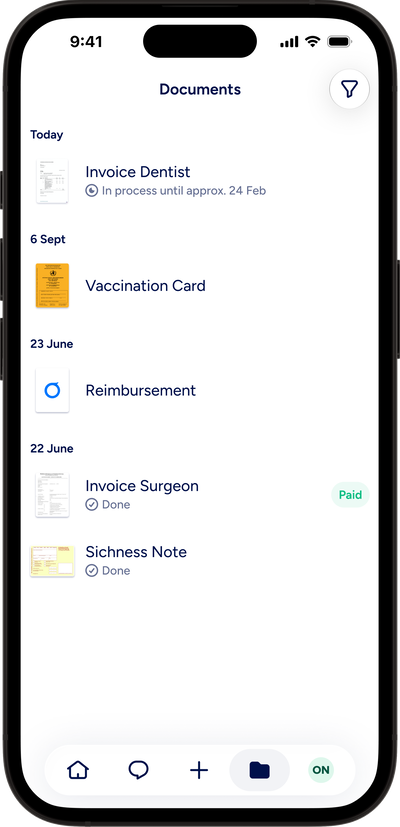
You can continue uploading additional invoices through the app and view the current processing status at any time.
In most cases, we reimburse you without any changes for your contract. And even if we have to review your invoice further, the matter can be fully clarified so nothing changes for you.
However, if it becomes apparent that relevant health information was omitted when the policy was taken out, contractual adjustments may become necessary. For example, a risk surcharge may be applied retrospectively.
In particularly serious cases, the policy may also be terminated if it is proven that false health information was deliberately provided.
For this reason, it is important to answer all health-related questions completely and truthfully when applying for private health insurance. If you later realize that you forgot to disclose important medical information, please contact us as soon as possible so that we can work with you to find an appropriate solution.
We do everything we can to help you make an informed, conscious decision that will benefit you for a lifetime.

Please choose a date if you want to determine the period yourself.
Please check your email inbox to confirm your appointment on - at -.

„Very helpful customer support that made the process super easy for me. Fast and totally friendly. That's the complete opposite of “poor service”!“

Unfortunately our chat is currently closed.
But you can also just leave your request here and we'll get in touch with you as soon as possible!

Deine E-Mail-Adresse wurdeerfolgreich bestätigt.
You have successfully confirmed
your appointment.
Would you like to book a new appointment instead?
You have successfully confirmed
your email address.
You have been unsubscribed from our newsletter.
By entering your data you agree to be contacted by ottonova via phone, SMS and email. Good to know:
 We will call you soon.
You have already booked an appointment with us. We will contact you on the following date/time. See you soon!
Thank you.
Please check your email inbox to confirm your appointment on at .
Please check your email inbox to confirm your email address.
This content is not permitted to load due to trackers that are not disclosed to the visitor. The website owner needs to setup the site with their CMP to add this content to the list of technologies used.
At ottonova, we strive to make our website as accessible as possible. Therefore, please use accessibility@ottonova.de exclusively for suggestions and comments regarding accessibility on the website.
Are you already insured with ottonova and have another issue? Please log in to the web app and contact us there. Please only share sensitive data such as health information in your secure area within the app or web app.
If you are not yet insured with us and have questions about our insurance products, please feel free to contact us via chat or email.